USCG CABLE SHIP PEQUOT - UNITED STATES
HARBOR DEFENCES
|
Boston Harbor 1941-45 and "The Battle of the Atlantic" |
This page provides more detail about the U.S. Coast Guard Cable ship Pequot during World War II. It tells about the facilities, role and strategic importance of the Pequot's home port of Boston in prosecuting the war in the Atlantic Ocean. Our main page for the USCG Pequot provides extra details about the ship, its crew, its purpose as well as links to our other Pequot pages. Research and design by by Chip Calamaio and Richard Walding.
 |
|
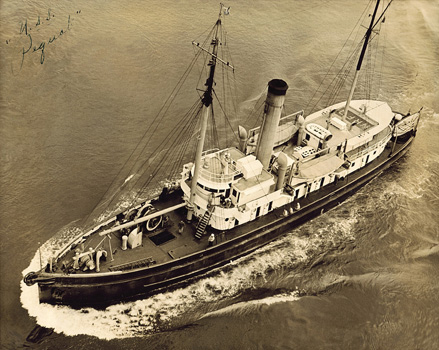
The US Coast Guard Pequot. During WWII this cable ship laid top secret Indicator Loop cables to protect harbors from German U-boats. Her mission ranged from the ports of Virginia up to Argentia, Newfoundland. (Calamaio family). |
 |
|
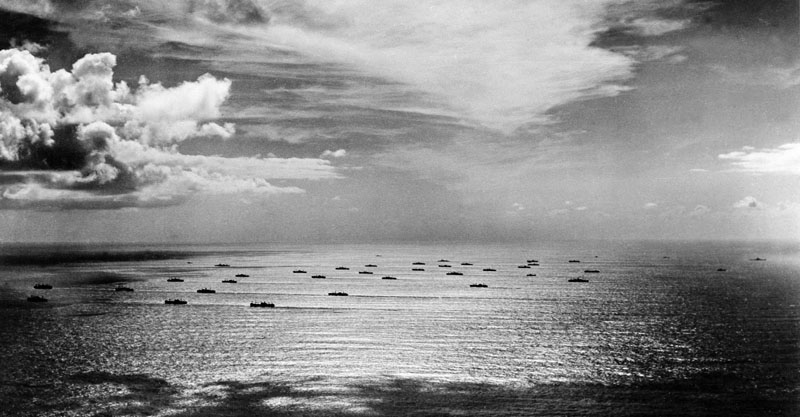
A convoy of supply ships and escorts
steaming East across the Atlantic1942 |
 |
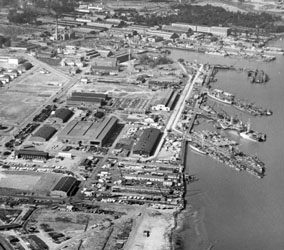 |
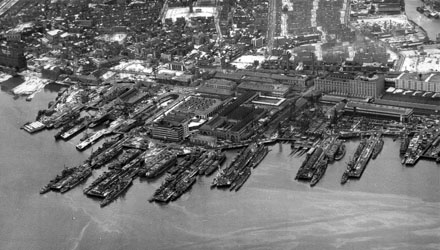
| 184B. The Boston Navy Yard was the home port of warships of all sizes and types during World War II. In addition to resupplying vessels between tours at sea the yard repaired and modified ships and quartered seaman and officers (Naval Historical Center) | 184C. The Charleston Navy Yard during WWII built and repaired hundreds of US and Allied warships. (Naval Historical Center) |
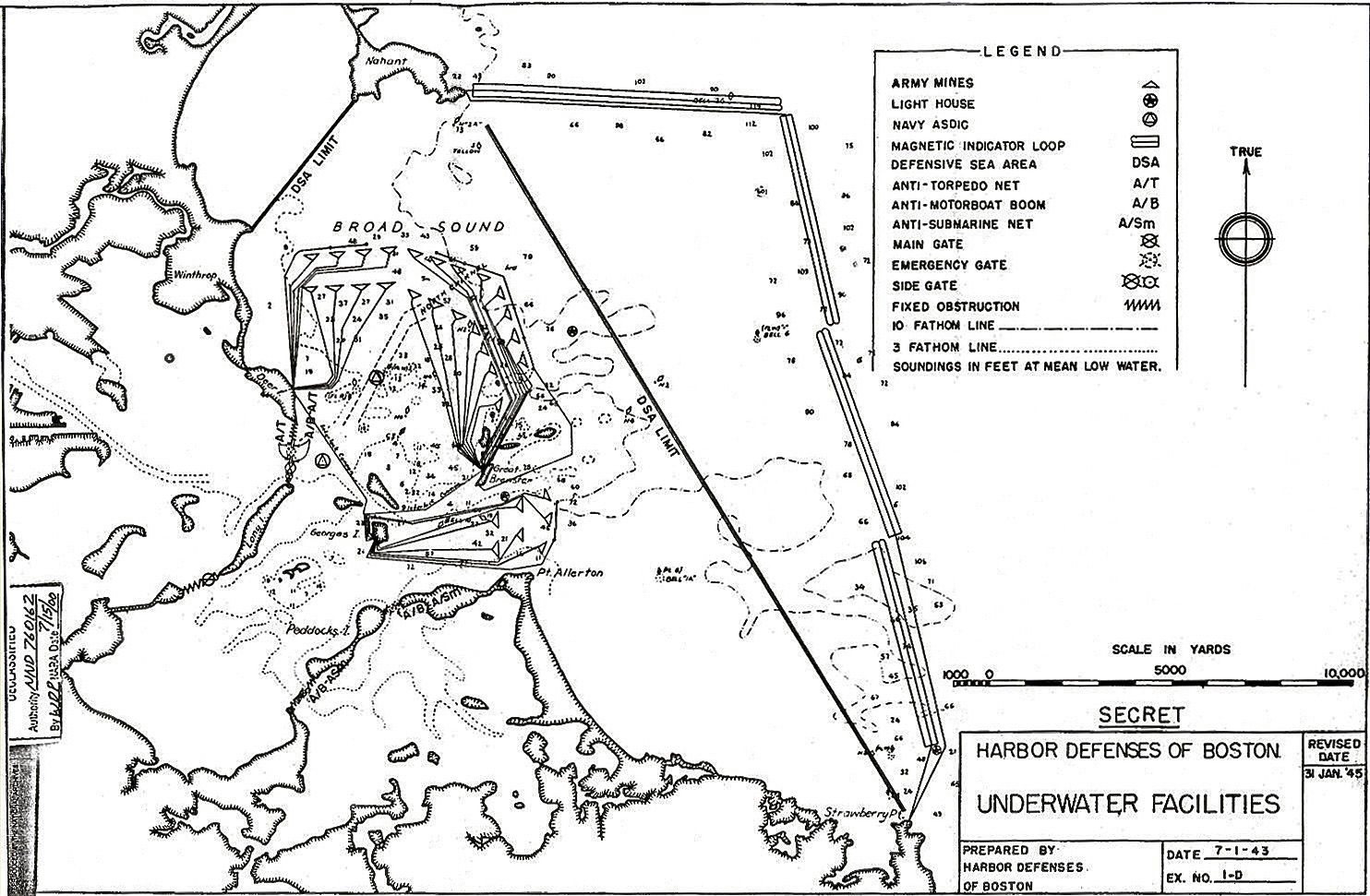
Military installations were everywhere. The entrance to the harbor
was heavily mined, anti-submarine netting was installed, as well as fixed
harbor defense Asdics (fixed sonar), and rows of hydrophones. For extra harbor
defense Pequot laid four anti-submarine indicator loops from
East Point, Nahant in a defensive circle around
Boston Harbor to Strawberry Point, Scituate.
 |
|
184D. This Secret chart of the “Harbor Defenses of Boston Underwater Facilities” was developed on July 1st 1943 and revised on January 31st 1945. It clearly shows the four indicator loop cables (each made of three "legs") protecting Boston Harbor. Two were operated from the Northern edge of the harbor in the Operations Building at East Point on the Nahant peninsula and two from the Strawberry Point shore station on North Scituate. This chart clearly shows the placement of sea mines, submarine nets, underwater ASDIC listening stations, and other components of the comprehensive defense system that was put in place to protect Boston’s Inner Harbor. In addition to these underwater defense measures the entire area was heavily protected by shore batteries of heavy guns, anti-aircraft gun placements as well as surface ships and air defenses. This chart wasn’t declassified until July 15, 2000. For more details on this loop installation visit Jerry Butler’s Nahant case study. Click Image To Enlarge ( National Archives and Records Administration, Boston) |
The Charlestown
Navy Yard, within the harbor, repaired American and British ships damaged by
the Germans and built destroyer escorts.
At peak production 50,000 people labored in the shipyards. They worked seven
days a week around the clock. The harbor
was constantly bustling with the movement of Navy ships, Coast Guard
Cutters, tugboats and cargo vessels. During the “Battle of the Atlantic”
more than 3,500 allied convoy vessels and 175 warships were lost to the
German U-boats which cost the lives of 30,248 merchant sailors. Many
freighters, tankers, and supply ships steamed out of Boston Harbor by the Pequot and
disappeared over the horizon never to be seen again.
Photos courtesy
Pequot Quartermaster
Lou Carhart
|
|
|
|
185. A view of the Navy Yard from the Boston Coast Guard Base during WWII. |
186. The Pequot at Constitution Wharf. A large air cowl is clearly seen to the right of the stack. Sailor Roger Calamaio told of a bunk down in the crew quarters that was directly under one of those air cowl shafts, “We called it pneumonia corner. When I first came aboard that's where they stuck me. I really gave it to 'em about that later.” |
|
|
|
|
187. A Chimo Class Auxiliary Minelayer (MMA). These ships placed mines at key points to protect Boston Harbor. A ship of this class, the Yamakraw (WARC-333) was converted by the Coast Guard for cable laying work in 1946 after the Pequot was decommissioned. |
188. USN Navy Patrol Escort (PCE) steaming into Boston Harbor - 1944. |
|
|
|
|
189. Busy harbor scene in 1944 with East Boston in the background - tough and rusty and raw. |
190. Convoy ship in harbor |
|
|
|
|
191. A camouflaged Crosley Class high speed transport heads to sea in search of U-boats. Lou's photos give a broader feeling of what the sailors experienced - the hustle and bustle and energy of a busy port during war time. |
192. Merchant ship cruising through Boston Harbor. A veritable rust bucket for desperate times. |
 |
 |
 |
|
193. USS LST-692 (later the USS Davies County). This landing ship which saw action in France passes by the Pequot. Landing barge 764 is topside which carried soldiers to the beach during invasions. Built in February of 1944, this WWII workhorse is still in service with the Philippine Navy as BRP Benguet (LT-507). (Mike Luongo) |
194, 195. During their Coast Guard careers many of the Pequot’s sailors pulled shore patrol and would have to “pound the beaches” often accompanied by specially trained German Shepherds, who with their keen sense of hearing and smell could often give sailors advance warning of an intruder. More than 2000 dogs were used by the Coast Guard to help patrol the Atlantic, Pacific and gulf coasts during WWII.“ (US Coast Guard photos) | |
 |
Just Vicious: Roger Calamaio said they were scary at times: “Those dogs were very alert and trained to kill. Whoever took it from the cage was it’s Master. I could spend hours with one of those dogs up and down the coast and we’d be just the best of friends. But if I put it back in it’s cage, and few minutes later somebody else took it out, and gave it the order to attack me, it would have. They could be just vicious.” |
Every effort has been made to trace and acknowledge copyright. The authors would welcome any information from people who believe their photos have been used without due credit. Some photos have been retouched to remove imperfections but otherwise they are true to the original.
FEEDBACK
If you have comments or queries specifically
about the Pequot or her Escort Ships, please contact
Chip Calamaio chipaz@cox.net,
Phoenix, Arizona, USA. (H) 602-279-450.
Click here to go to the Pequot Main Page.
Research and design: Chip Calamaio and Richard Walding


